
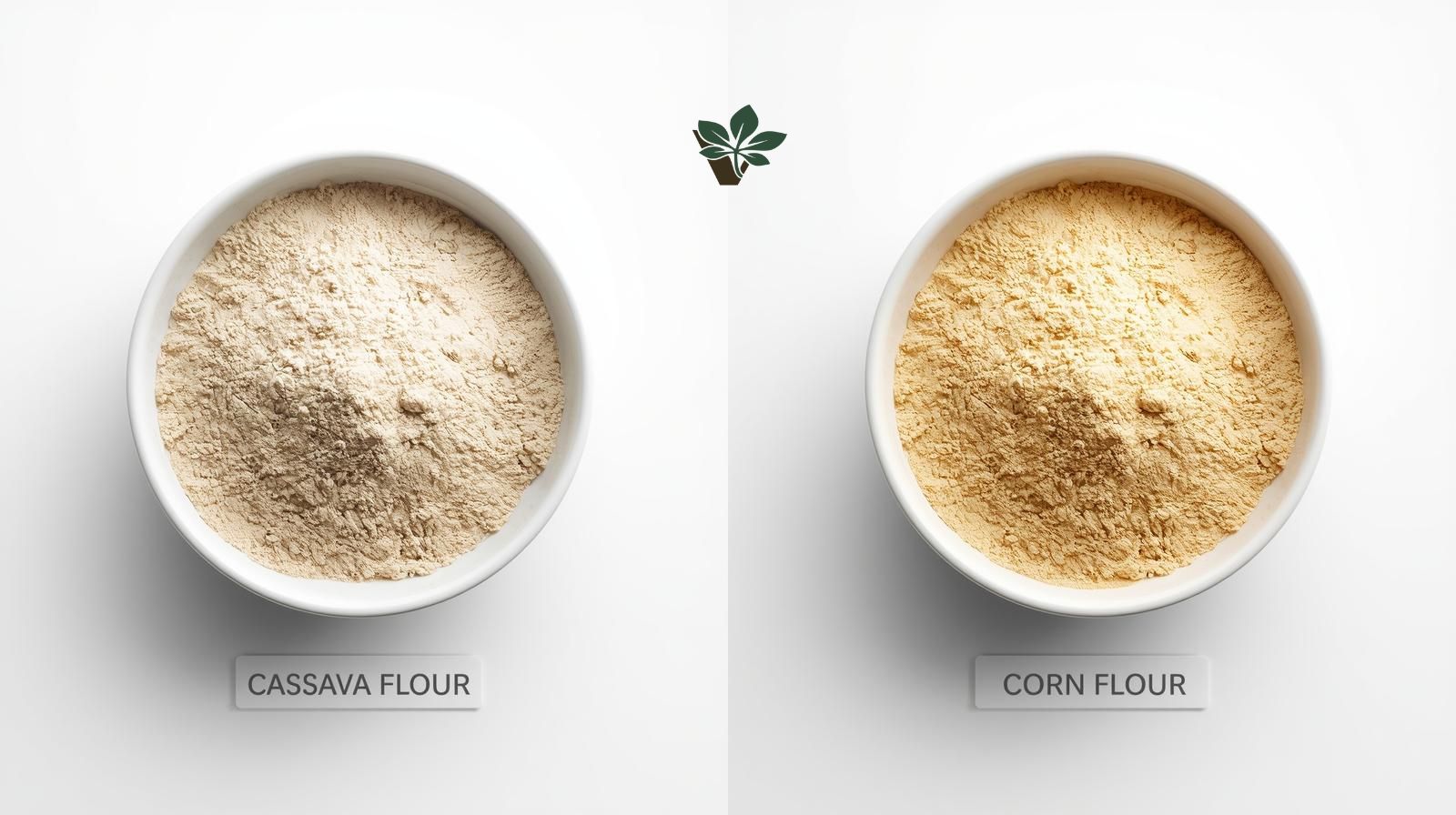
When comparing cassava flour vs corn flour, it’s easy to assume they are similar because both are gluten-free, versatile, and popular in African, Asian, and Latin American cooking.
But the truth is, they come from entirely different botanical sources, behave differently in recipes, and offer distinct nutritional and functional benefits.
In this guide, we break down everything you need to know, including:
✔ Botanical origin
✔ Nutritional composition
✔ Processing methods
✔ Taste & texture
✔ Best culinary uses
✔ When to use cassava flour vs corn flour
✔ Key FAQs (including diabetics-focused questions)
✔ Differences between tapioca starch and cassava starch
Whether you’re a chef, home cook, food manufacturer, or bulk buyer, this article gives you clarity on making the right choice, especially if you’re considering high-quality Nigerian cassava products from Verdantis Agro, one of the leading cassava processing factories serving exporters and bulk buyers globally.
Let’s Explore Cassava Flour vs Corn Flour
1. Botanical Source: Where Do They Come From?
Cassava Flour
- Made from the whole root of the Manihot esculenta plant (cassava/yuca).
- The cassava root is peeled, washed, dried, and milled into a fine flour.
- It is a root-based flour, similar in category to yam flour or potato flour.
Corn Flour (Maize Flour)
- Produced by milling dried kernels of Zea mays (corn/maize).
- Usually comes in yellow or white variants depending on the type of maize.
- This is a grain-based flour, similar to wheat flour or sorghum flour.
Key Difference:
Cassava flour comes from a root, making it naturally grain-free, while corn flour is a cereal-grain product.
2. Cassava Flour vs Corn Flour Nutritional Composition
Below is a simplified comparison of both cassava and corn flour per 100g (values vary by region):
| Component | Cassava Flour | Corn Flour |
|---|---|---|
| Calories | Higher | Moderate |
| Carbohydrates | High | High |
| Fiber | Moderate | Low–Moderate |
| Protein | Low | Higher than cassava |
| Fat | Very low | Low |
| Micronutrients | Rich in vitamin C, potassium | Rich in B-vitamins & magnesium |
| Gluten-Free | Yes | Yes |
Is Cassava Flour Healthier?
Cassava flour tends to be:
- EASIER to digest
- GENTLER on the stomach
- Less allergenic
- Lower in anti-nutrients compared to corn flour
However, cassava is higher in carbs and calories but often lower glycemic than corn, depending on processing.
3. Taste & Texture Differences
Cassava Flour
- Mild, neutral taste
- Smooth texture
- Closest gluten-free alternative to wheat flour
- Makes soft, elastic doughs (great for baking and swallow meals)
Corn Flour
- Slightly sweet, earthy taste
- Can feel a bit sandy or rough if it’s not ground smoothly.
- Doesn’t easily stretch or give that “elastic” feel you get from gluten.
Verdict: Cassava flour provides a more neutral, wheat-like experience, especially for baking.
4. Processing Methods
Cassava Flour
You can produced cassava flour by:
- Peeling
- Washing
- Grating or chip slicing
- Fermenting (optional)
- Drying
- Milling into fine flour
Trusted producers and suppliers like Verdantis Agro ensures your cassava flour contains:
- Low moisture
- No impurities
- Stable shelf-life
- Hazard Analysis and Critical Control Points (HACCP) compliant processing
Corn Flour
Typically, industrial yellow corn flour may undergo fortification or heat treatment. However, corn flour can be produced by:
- Cleaning & dehulling maize
- Grinding/milling
- Sieving
- Packaging
5. Culinary Uses: When to Use Each One
Common Uses for Cassava Flour
- Gluten-free baking (bread, cookies, pastries)
- African swallow meals (Fufu varieties)
- Tortillas & flatbreads
- Thickening soups and sauces
- Frying (it creates excellent crispiness)
- Paleo, AIP, Whole30 diets
Best Uses for Corn Flour
- Cornbread & corncakes
- Snacks (chin-chin, puff snacks, pap preparations)
- Thickening sauces
- Batter mixes
- Pancakes
Can You Replace One With the Other?
- For baking: Cassava flour can replace wheat flour better than corn flour can.
- For thickening: Cassava starch works better than cassava flour.
- For frying: Both work, but cassava gives a lighter crisp.
How About Cassava Starch vs Tapioca Starch: Are They the Same?
Essentially, every tapioca starch is derived from cassava, but not every cassava starch qualifies as tapioca starch. It’s a subtle yet important distinction, even though both come from the same root.
Cassava Starch
- Extracted from the whole cassava root
- Pure, white powder
- Used for thickening, binding, and food processing
Tapioca Starch
- A type of cassava starch processed differently
- More refined
- Produces clearer, glossier gels
- Common in bubble tea pearls, desserts, and chewy snacks
Shop Cassava Roots From Nigeria’s Leading Cassava Processing Factory – Verdantis Agro Produce
If you are an exporter, food processor, or bulk buyer, we offer:
✔ Farm-fresh, high-quality cassava roots harvested from controlled farms with consistent quality.
✔ Best wholesale prices suitable for small and large scale.
✔ Local delivery or global export shipping
✔ Quality assurance & compliance
If your business needs ca fresh tubers, choose Verdantis Agro. We remain one of Nigeria’s trusted supplier for Africa, Europe, Asia, and Middle Eastern markets.
FAQ’s About Cassava Flour vs Corn Flour
Cassava flour is healthier for people seeking a grain-free, gluten-free, and allergen-friendly option. It is easier to digest and contains fewer anti-nutrients compared to corn flour.
Yes. Cassava is gentler on the stomach and generally easier to digest than corn, which contains more insoluble fiber and anti-nutrients like phytic acid.
Not directly.
Cassava flour is made from the whole root.
Cassava starch (or tapioca starch) is the correct substitute for corn starch.
For thickening:
Use cassava starch, not cassava flour.
This answers the query: “can I use cassava starch instead of cornstarch” — YES.
Cassava starch is an excellent substitute.
Depending on your health goals, top options include:
Almond flour
Coconut flour
Cassava flour
Whole wheat flour
Millet or sorghum flour
Cassava flour is particularly good for gluten-free, AIP, Paleo, and Whole30 diets.
Cassava is high in carbohydrates, so it can raise blood sugar but less sharply than corn, depending on the processing. Fermented cassava flour has an even lower glycemic impact.
In many cases, yes.
Cassava generally has:
Lower glycemic index than white rice
Fewer processed starches
More resistant starch (good for blood sugar control)
The best options include:
Resistant starch (from cassava, plantain, potatoes)
Tapioca starch (in moderation)
Arrowroot starch
These digest more slowly than cornstarch
For gluten-free or grain-free diets, YES.
Cassava flour behaves most like wheat flour but without gluten, making it ideal for healthy baking.
Tapioca starch is a refined form of cassava starch; lighter, clearer, and more elastic. Cassava starch is broader in application.
Often yes, cassava flour’s texture is the closest wheat alternative. Some recipes require slight liquid adjustments.
In a nut shell, when it comes to cassava flour vs corn flour…
Both are extremely valuable ingredients that serve different dietary roles and culinary functions.
- If you want a wheat-like, gluten-free flour → choose cassava flour.
- For traditional maize-based foods → choose corn flour.
- For thickening → use cassava starch or tapioca starch as a cornstarch replacement.
And for bulk purchasing, export-ready quality, or industrial supply, always keep in mind that Verdantis Agro remains one of Nigeria’s most reliable sources of high-quality cassava roots at unbeatable wholesale prices.